Fundamentals of Data Science

Day 1 | WISE Workshop — Addis Ababa 2026

Sean Sylvia, Ph.D.

February 2, 2026

Learning Objectives

By the End of This Session, You Will…

  1. Distinguish between statistics, econometrics, and machine learning approaches
  2. Identify when prediction vs. causal inference is the right goal
  3. Understand how ML fits into the workshop’s overall pipeline
  4. Articulate prediction challenges in your own supply chain context

The Data Revolution in Health

A Transformative Moment

Health systems across Africa are experiencing an unprecedented data explosion.

What’s Changing

  • Electronic inventory systems
  • Digital health records
  • Mobile health platforms
  • Real-time reporting

The Opportunity

  • Earlier detection of problems
  • More efficient resource allocation
  • Evidence-based policy decisions
  • Improved health outcomes

Discussion: What data sources does your organization currently use? What challenges do you face?

AI as Economic Transformation

Economics of Digitization:

Reduction in (Marginal) Costs

Cost Type Healthcare Application
Search Costs Instant medical literature access, symptom lookup
Replication Costs Digital health records, AI models deployed at scale
Transportation Costs Telemedicine, remote monitoring, digital consultations
Tracking Costs Continuous patient surveillance, automated data collection
Verification Costs Digital identity, online reputation systems, trust mechanisms

The Dream: AI-Enabled Healthcare

What AI Can Do

  • Extend specialist expertise to frontline workers
  • Standardize care quality across settings
  • Enable continuous learning from practice
  • Reduce diagnostic delays

The Sustainability Question

  • Can AI systems improve and remain equitable over time?
  • Will they work for hard-to-reach populations?
  • How do we design for long-term rather than short-term gains?

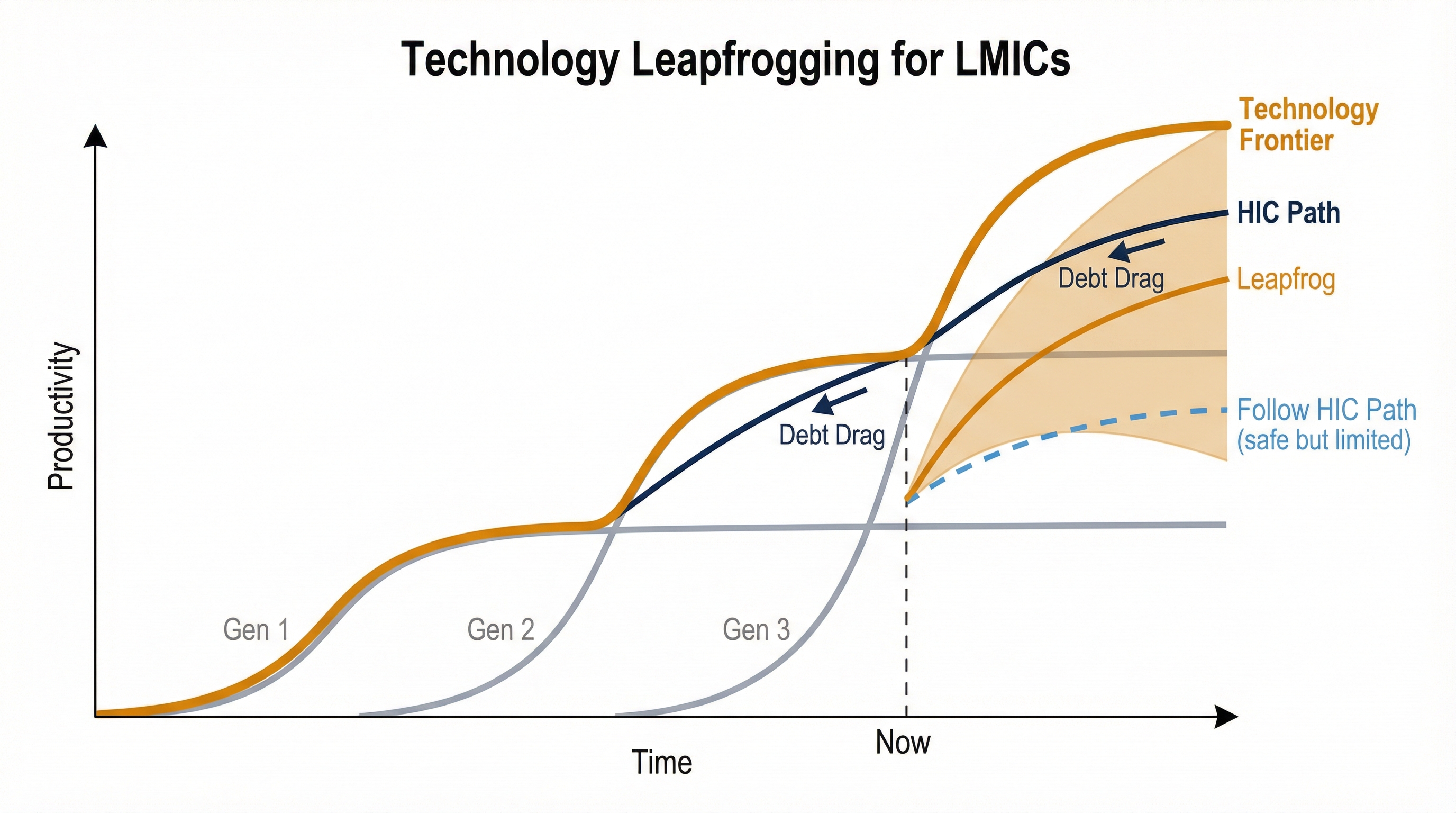
The Leapfrog Opportunity {.center}

The Choice LMICs Face

Option 1: Follow the HIC Path

  • Safe, proven trajectory
  • Limited by legacy infrastructure
  • Ceiling set by institutional debt

Option 2: Leapfrog to the Frontier

  • Skip legacy systems entirely
  • Higher potential productivity
  • But significant uncertainty

The Question

How do we capture the leapfrog opportunity while managing the risk?

AI is Different
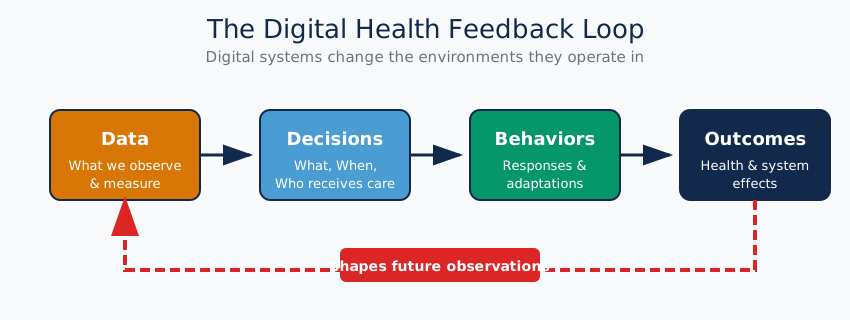
The Complexity

  • Data shapes decisions → decisions change behaviors
  • Behaviors generate new data → feedback loops
  • Yesterday’s patterns ≠ tomorrow’s reality
  • Unknown unknowns we can’t predict upfront

The Core Insight

Health systems are information-processing and decision-making factories.

Digital systems transform the factory floor—not just how care is delivered, but what care, when, and to whom.

We must learn about the system before deploying—and design to learn continuously after.

AI Often Fails In Healthcare

System Scope Key Failure Real-World Impact
Epic Sepsis Model 56% of US hospitals Missed 67% of cases, false alerts 88% of the time Delayed treatment, alert fatigue
IBM Watson Oncology Major hospitals globally Unsafe treatment recommendations $62M+ wasted, quietly discontinued
SkinVision App Consumer market 235% worse performance with rotation Missed melanomas, health disparities
COMPAS (Criminal Justice) 46 US states 44.9% vs 23.5% false positive rates Systematic racial bias in sentencing

Pattern: Technical validation ≠ Real-world success

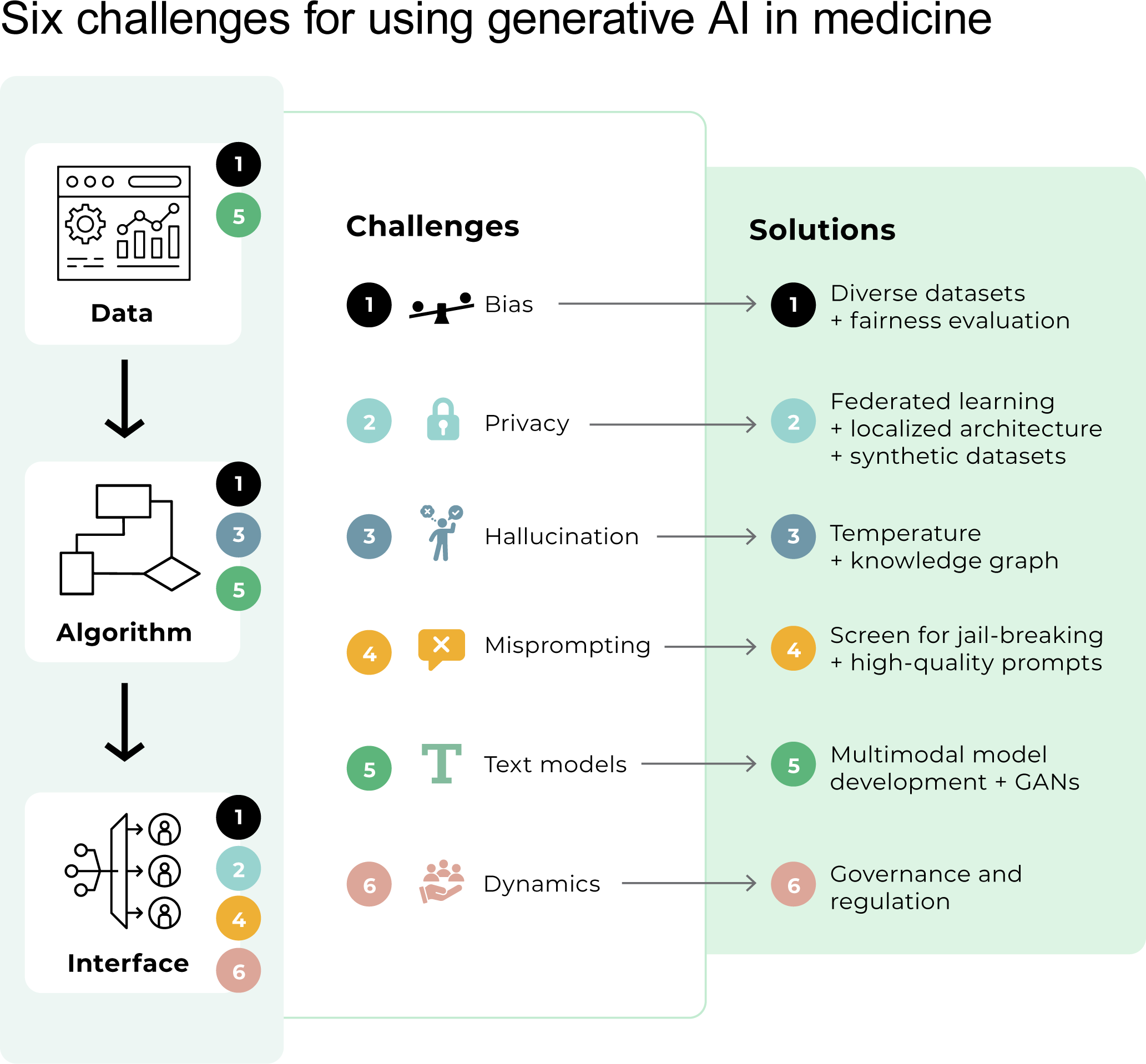
Six Challenges to AI Adoption

ECAM: Four Principles for Sustainable AI

ENGAGE

Stakeholders First

  • Map stakeholders before building
  • CHWs, patients, officials
  • Co-design, not consultation

CALIBRATE

Local Context

  • Train on local populations
  • Local languages, diseases
  • Don’t import HIC models

AUDIT

Bias Continuously

  • Equity audits by subgroup
  • Gender, geography, SES
  • Check for hallucination

MONITOR

Adapt Continuously

  • Human override mechanisms
  • Retraining triggers
  • Performance dashboards

Templin et al. (2024) PLOS Digital Health | Templin et al. (2025) npj Digital Medicine

What Is Data Science?

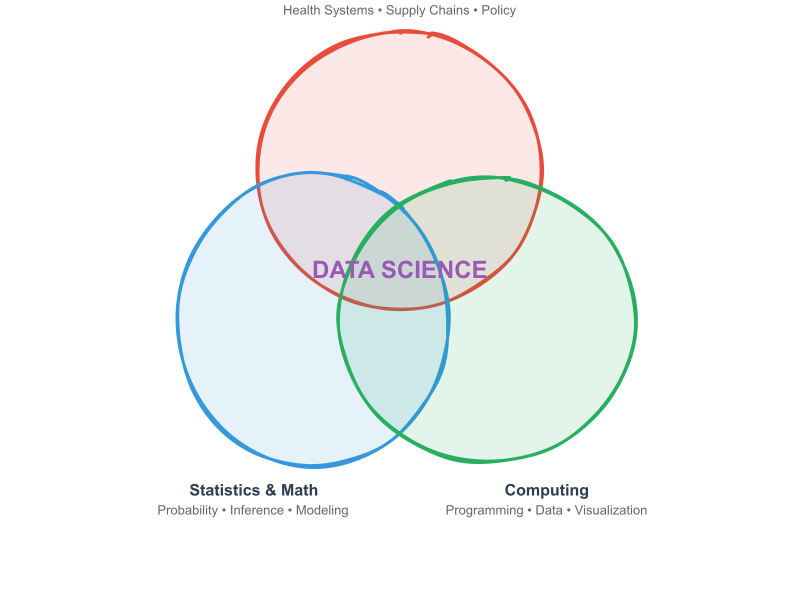
The Intersection of Three Fields

Venn diagram showing data science as the intersection of domain knowledge (health systems, supply chains, policy), statistics and math (probability, inference, modeling), and computing (programming, data management, visualization)

Data science sits at the intersection of domain knowledge, statistics, and computing

Your domain expertise is essential — algorithms alone cannot solve health system challenges.

The Fundamental Question

Can We Predict Health Outcomes Accurately?

This is the core question that motivates modern data science in health.

Traditional Statistics

  • Focus on inference (\(\hat{\beta}\))
  • Understanding relationships
  • Hypothesis testing
  • Causal interpretation

Machine Learning

  • Focus on prediction (\(\hat{y}\))
  • Minimizing forecast error
  • Out-of-sample performance
  • Pattern recognition

Both approaches are valuable — the key is knowing when to use each.

Supply Chain Prediction Tasks

How can prediction improve pharmaceutical supply chains?

Task Traditional Approach ML Approach Benefit
Demand Forecasting ARIMA, exponential smoothing Random forests, gradient boosting Captures complex patterns
Stockout Risk Threshold rules Ensemble classification Earlier warning
Lead Time Estimation Average + buffer ML with facility features Facility-specific estimates
Expiry Prediction Simple ratios Pattern learning Waste reduction

Ethiopia’s Pharmaceutical Supply Chain

The Context

Scale & Complexity

  • EPSA manages distribution nationwide
  • 3,500+ health facilities served
  • 1,000+ essential medicines tracked
  • Multiple distribution tiers

Key Challenges

  • Medication stockouts
  • Demand variability
  • Transportation constraints
  • Information gaps

Three Paradigms of Quantitative Analysis

Statistics, Econometrics, and Machine Learning

Approach Primary Goal Key Question
Statistics Estimation & inference “What is the relationship?”
Econometrics Causal identification “What is the effect?”
Machine Learning Prediction “What will happen next?”

The “Beta-Hard” vs “Y-Hard” Distinction

  • Beta-hard tasks: We care about why — causal or structural inference
  • Y-hard tasks: We care about what — accurate prediction is the goal

When to Use Each Approach

Scenario Best Approach Example
Testing if an intervention works Econometrics Does the new distribution policy reduce stockouts?
Understanding which factors matter Statistics Which facility characteristics correlate with stockouts?
Forecasting next month’s demand ML How much of Drug X should we deliver to Region Y?
Optimizing resource allocation ML Which facilities are highest risk for stockouts?

In practice, we often combine approaches — this workshop shows you how.

The Prediction-Simulation Connection

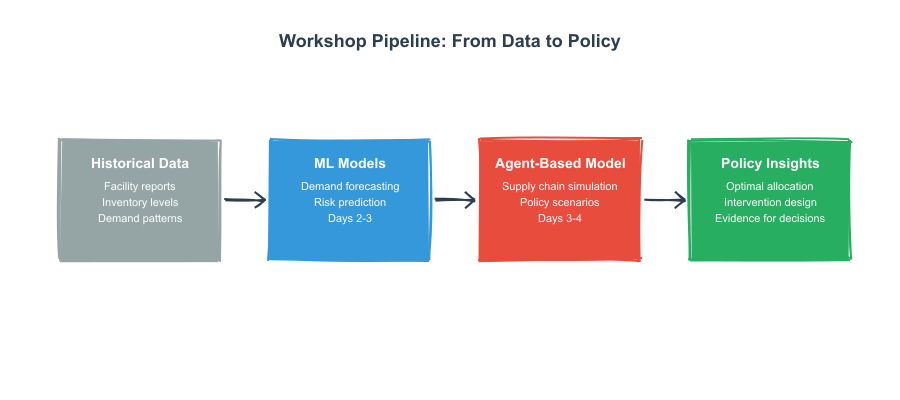
How This Workshop Fits Together

Flowchart showing workshop pipeline: Historical Data (facility reports, inventory levels, demand patterns) flows to ML Models (demand forecasting, risk prediction, Days 2-3) flows to Agent-Based Model (supply chain simulation, policy scenarios, Days 3-4) flows to Policy Insights (optimal allocation, intervention design, evidence for decisions)

The workshop pipeline: from data through ML models and simulation to policy insights

ML predictions feed simulation models — enabling “what if” policy analysis.

ML Is About Prediction

An Important Clarification

Important!

Machine Learning is about prediction. Period.

It does not magically solve the causal inference problem.

What ML CAN do:

  1. Provide accurate forecasts for planning and allocation
  2. Identify high-risk facilities or products for intervention
  3. Help strengthen causal analyses in specific ways (we’ll see this later)

What ML CANNOT do:

  • Tell you why something happens
  • Prove that changing X will cause Y to change
  • Replace careful study design for causal questions

A Concrete Example: Poverty Targeting

The Task

Governments need to identify poor households for social assistance programs.

Traditional approach: Survey everyone (expensive, slow)

ML approach: Predict consumption from observable characteristics

How It Works

  1. Survey a sample of households
  2. Train ML model: characteristics → consumption
  3. Apply model to rank all households
  4. Target resources to highest-need predictions

Result: Same budget reaches more people in need

Key insight: This is purely predictive — the model doesn’t explain why households are poor, but it identifies who is poor.

What This Workshop Will Build

Day-by-Day Preview

Day Focus What You’ll Learn
Day 1 Foundations Reproducible research, project setup
Day 2 ML Pipeline Forecasting models, evaluation methods
Day 3 Integration Connecting ML outputs to simulation
Day 4 ABM Deep Dive Agent-based modeling for policy

By the end: You’ll have built a complete pipeline from data to policy-relevant predictions.

The Data Science Mindset

Five Principles for This Week

  1. Prediction is not causation — Always ask “what question am I answering?”

  2. Out-of-sample performance matters — Models that memorize data are useless

  3. Domain expertise is essential — Algorithms can’t replace your knowledge

  4. Reproducibility is non-negotiable — Code and documentation matter

  5. Perfect is the enemy of good — A useful model today beats a perfect model never

Your Role This Week

Bringing Your Expertise

What You Bring

  • Understanding of your health system
  • Knowledge of supply chain realities
  • Awareness of data quality issues
  • Ideas for relevant applications

What We’ll Provide

  • Technical methods and tools
  • Hands-on practice opportunities
  • Templates and code examples
  • Frameworks for thinking about problems

The best outcomes come from combining both — methods without context are just math.

Discussion: Your Supply Chain Challenges

Let’s Hear From You

In small groups (3-4 people), discuss:

  1. What prediction problems do you face in your work?
    • What would you want to forecast more accurately?
  1. What data exists that could help?
    • What’s available? What’s missing?
  1. What decisions would better predictions improve?
    • How would you use the predictions?

Time: 5-7 minutes in groups, then brief sharing

Key Takeaways

Remember This

Prediction vs. Causation

What ML gives you:

  • Accurate predictions (\(\hat{y}\))
  • Pattern recognition
  • Risk stratification

What ML does NOT give you:

  • Causal effects (\(\hat{\beta}\))
  • Mechanism understanding
  • Policy counterfactuals

For “Why?” questions, we need careful study design. For “What’s next?” questions, ML is powerful.

What’s Next

Rest of Today’s Schedule

Time Session Description
10:30-10:50 Break
10:50-12:30 Data Science in Public Health Policy Ozawa
12:30-1:30 Lunch
1:30-3:00 ML Foundations: Core Concepts Sylvia
3:00-3:20 Break
3:20-5:00 Hands-on: Setup + ML Demo Sylvia

Afternoon hands-on: We’ll set up everything you need for the rest of the week.

Questions?

Before We Continue

About Concepts

  • ML vs. statistics
  • When prediction matters
  • Workshop structure

About Practice

  • Technical requirements
  • What we’ll build
  • How to prepare

No question is too basic — we’re all learning together.